When is the last time you spent your Saturday evening thinking about the correct use of a prepositional phrase? Or whether a comma belongs before a coordinating conjunction? Or whether you just used a dangling modifier and accidentally made it sound like your research paper stepped into the room wearing flip-flops?
Exactly. Research papers do not wear flip-flops.
Most of the world does not walk through life thinking about the mechanics of grammar, even though it can become blatantly obvious when those mechanics are misused. We send messages and use written language on a daily basis without giving much attention to correct punctuation. We simply trust that the other person will understand what we are trying to say. This usually works fine until we are asked to “synthesize,” “critically evaluate,” or “support our argument with scholarly sources.”
Somewhere along the way in my educational journey, English became secondary to the lesson plan. I can remember spending a significant amount of time in early elementary school correcting sentences, identifying independent clauses, and circling dependent clauses. I remember textbooks full of typed paragraphs accented with tiny red corrections to show us what was wrong within each sentence. These activities were always paired best with a good popcorn reading of our class story for the week. I still despise reading out loud.
I am not exactly sure what year everything changed, but at some point, school became more about reading and writing papers and less about learning how to write well. I guess it was assumed that our third- and fourth-grade skill levels from those grammar books were enough to get us through. I am not necessarily blaming the teachers, or anything for that matter. I truly do not know where the shift took place. It could have been a change in the standardized curriculum, or just as easily, it could have been that I did not learn the depth of what I needed from those early years to feel confident in my writing abilities. Nonetheless, I found myself sitting in my first college English course, ENGL 1101, facing a harsh reality.
I did not know how to write.
I need to take a moment to give credit where credit is due to my professor, Professor B, who quite literally humbled and helped me all at once. She will always get the credit for being the reason I fell in love with writing. Her class had a reputation, and I knew that when I signed up for it. In fact, I was told I would probably not earn an A in her course. I saw it as a challenge I was willing to accept. After all, they knew nothing about my academic ability.
It turns out, they knew exactly what they were talking about.
From the first day of her course, I began calculating exactly how many points I would need just to pass, let alone get an A. I knew quickly that this would not be one of those courses where everyone floated through on good intentions and a mildly coherent final paper. By the first half of the semester, I was confident that even the Fs were having to work hard for their place in her gradebook. She expected effort. She expected preparation. She expected hard work, dedication, and most importantly, resilience. Giving up was never an option, whether our grade on a paper matched our age or our shoe size. She kept pushing.
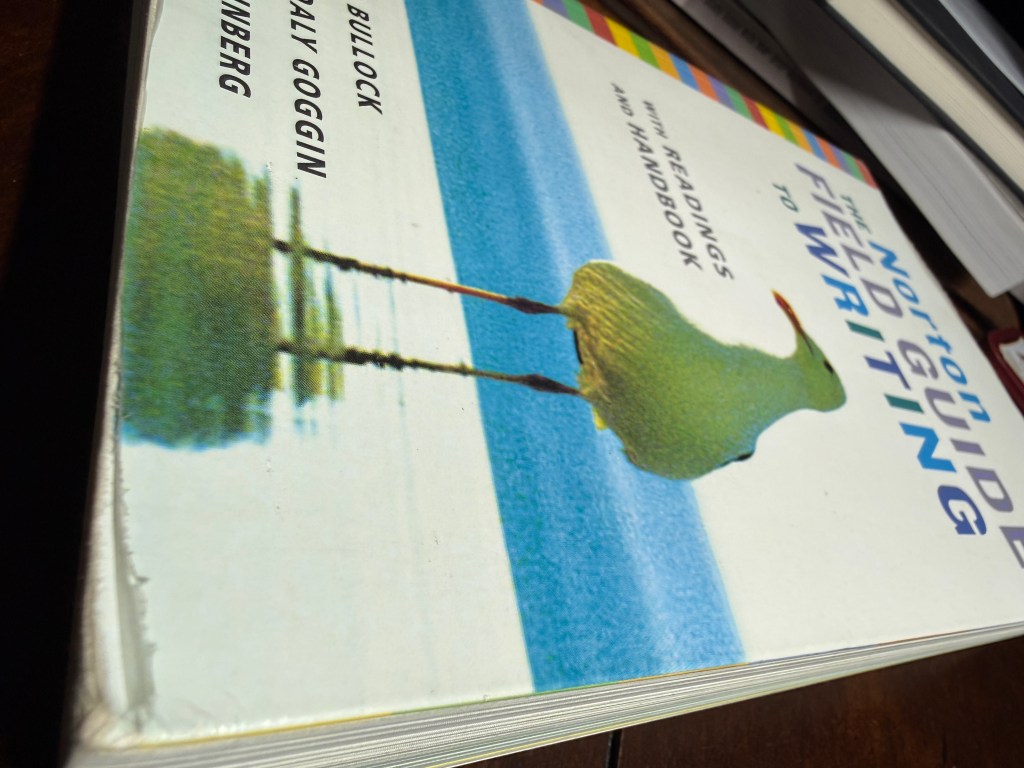
I am thankful for the way she was passionate about her craft. I am also thankful that I decided to purchase my textbook for that course, The Norton Field Guide to Writing. It was one of the only books from my prerequisite courses that I did not rent. I think Professor B would appreciate the fact that I still use it from time to time.
In ENGL 1101, I was taught something beyond what it meant to write a correctly formatted APA college paper. I was taught how to respect the work. In fact, I became captivated by writing. I worked extremely hard in that course because I realized writing was something I needed if I wanted to become an educator. I am most proud of earning an A in her course, probably to her surprise and mine. I still, to this day, do not know how I pulled that one off, but I can say I must have enjoyed it because I decided to sign up for her ENGL 1102 course.
Looking back on that journey, I can see that I was never incapable of writing. I had thoughts, probably too many. I had ideas. Lord knows I had opinions. The issue was that I did not always know how to organize them so the reader could follow along. I did not fully appreciate the correct use of punctuation until I learned how necessary it was. I learned to realize that writing reveals not only the quality of our thinking but also its structure. We can have profound ideas and still find it challenging to deliver them in a meaningful way.
The reason I wanted to share this as part of my PhD journey is that writing is such an important part of earning this degree, or any degree, for that matter. Doctoral work requires a person to read deeply, think carefully, argue responsibly, and write clearly. It requires learning how to organize thoughts and ideas in a disciplined, structured way. Good writing is about delivery. It is the bridge between what is happening in your mind and what another person is able to understand. When writing is disorganized or grammatically incorrect, thoughts become unclear or are misunderstood. Whether anyone will admit it or not, when something is poorly written, the reader starts silently bargaining with God for the paragraph to end. I have been there.
For me, writing has continued to be a work in progress. I wish I could say there was a magical moment when everything changed, the Holy Spirit descended like a dove, and suddenly I knew how to write a proper APA research paper. The truth is that I got better in my writing by reading better writers. I started reading and paying attention to the rhythm of sentences. I realized that there was actually something to the writing process, rather than allowing the rough draft to serve as the revised copy and the final draft.
My encouragement to you is that you have everything you need to be successful as a writer. Whether you are earning a PhD or simply trying to pass your ENGL 1101 course, nobody becomes a strong writer by accident. Writing well is an art of discipline, restraint, clarity, and enough humility to remove a sentence because it served absolutely no purpose except making you feel poetic.
Another reason I wanted to share this is that it is becoming blatantly obvious that reading and writing are not respected the same way they once were. Nothing reveals this more than asking people if they have read a book I am interested in and receiving a blank stare in return. Or initiating World War III with my child over reading and writing a book report, while trying to convince him that it really does require reading the book.
In my opinion, for what it is worth, the single most important factor in becoming a better writer is becoming a better reader. Writing and reading have become deeply connected for me. The more I read, the better I write. The more I write, the better I read. Reading trains the ear and sharpens the eye. Writing enhances the mind. Together, they help form a person who can think with more patience, precision, and honesty. That matters in doctoral work because the goal should be more than sounding intelligent. The goal is to become the kind of person who can handle complex ideas responsibly and communicate them well to others.
Here is where the cultural divide starts to appear. Artificial intelligence has decided to enter the conversation, wearing a blazer and acting as if it were invited to the meeting.
I want to be perfectly clear on my position concerning the use of artificial intelligence. I know this may not be the popular opinion, and I am fine with that. My PhD is in psychology, not popularity. I do not mind going against the grain. I believe AI can be an incredible resource. I know there are some who believe otherwise. I will be the first to say that I use it, and I am grateful for what it has allowed us to accomplish in terms of efficiency. It can help with brainstorming, organizing, revising, simplifying, summarizing, and occasionally rescuing a sentence that looks like it has been through spiritual warfare. When we understand how to use it responsibly, AI can function like a writing partner, tutor, editor, and friend who gently says, “This paragraph is doing too much.” And sometimes the paragraph is absolutely doing too much.
However, I want to clarify that there is no scenario in which the use of AI should replace our ability to do something. There is a difference between using it as a supplemental resource and allowing it to replace our skills altogether. In my opinion, if you do not know how to do it yourself, then until you learn, AI should be off-limits. Yes, that even includes writing an annotated bibliography using correct APA citations.
I have an issue with using AI as a replacement rather than a reinforcement. When we can ask AI to produce a clean paragraph but do not know how to write one ourselves, it damages our culture intellectually. Writing teaches us how to think, revise, clarify, and evaluate. When that process is skipped entirely, we may produce words without building wisdom. I can assure you that our culture does not need any assistance with reducing wisdom. We need to preserve as much of it as possible.
AI can expand options, expose weaknesses, and offer structure when our brains are tired from reading the same sentence thirty-seven times. But AI cannot enjoy a sentence for us. It cannot develop taste for us. It cannot teach us to love books by doing the reading for us. There is still something deeply human about writing well. It requires judgment, patience, humility, imagination, and the willingness to admit that the first draft may need another chance or three.
Our culture has made it acceptable to fake it until we make it. I understand the phrase. I have lived the phrase. There are moments when you are learning as you go, using every resource available, praying over the submit button, and hoping your argument makes more sense to the professor than it currently does to you. There are times when it can be acceptable to fake it until we make it, as long as we are putting forth the effort to not stay there. Growth usually begins before confidence arrives. However, borrowed competence can only carry a person so far.
When writing academically, it can be difficult to fake it until we make it when we have absolutely no clue what a thesis is doing. We need to understand how evidence supports an argument. We need to recognize when a paragraph has wandered off into the woods or keeps circling the roundabout. We need to hear when a sentence is technically correct but rhythmically ugly. And we certainly need to know how to revise, because first drafts are usually less like finished products and more like raw footage from a documentary no one agreed to watch.
I enjoy writing now because I understand it differently. Writing gives me a way to think, teach, process, argue, reflect, and connect. It is one of the reasons I started writing blogs. It gives me a place to pour out my ideas and invite you along to sort through them with me. Am I the best writer I know? Absolutely not. I still make plenty of errors and ramble on and on. But I have come to appreciate the art of writing well, and I have developed a passion for continuing to grow in my ability.
As someone pursuing a PhD in Psychology with a focus on theology, I constantly work with ideas that warrant careful handling. Psychology, theology, formation, identity, attention, discipleship, and human development deserve more than vague inspiration and pretty phrases. They require precision, compassion, and clarity. When writing is done well, it gives complex ideas room to breathe. It helps truth travel. It allows you to be part of the journey by sharing ideas in a blog like this.
This journey is teaching me that writing well is part of becoming the kind of scholar, teacher, and communicator I want to be. It is slow work. It is frustrating work. It often involves deleting the sentence I liked most because apparently “liking it” is not a valid structural purpose. Rude, but fair.
I still have plenty to learn. I still revise more than I want to admit. I still occasionally stare at a sentence like it has personally betrayed me. But I am learning that writing is a craft. It can be practiced, strengthened, studied, and refined. And in a world where AI can help us produce words faster than ever, knowing how to write well may matter even more. The future will belong to people who can think clearly, judge wisely, communicate honestly, and use every tool available without surrendering the human responsibility to understand what they are saying.
I may have started as someone who struggled to understand writing, but I have become someone who genuinely loves it. I love the craft of it. I love the discipline of it. I love the challenge of making words carry meaning without collapsing under the weight of my own overthinking. I love a sentence that lands. I love a paragraph that moves. I love a book that reminds me why language still matters. I still fight with commas. I still revise as if my grade and reputation are both standing in the room watching me. I still wonder why some sentences refuse to cooperate until the fourth draft. But now, at least, I know why we are fighting.
And honestly, I kind of enjoy it.
So yes, writing is a PhD survival skill.
But it is also one of the great joys of the journey.
Discover more from Coenology
Subscribe to get the latest posts sent to your email.


Leave a Reply